Now that the journey’s over, I have an excellent opportunity to catalog everything in my pack. While I could have been better about it, I did a decent job of inventorying it all. I can look at each item here and draw from my experience as to it necessity and it’s usefulness. Hopefully this will provide a solid point of reference in planning my future trips.


Before and after (left & right).
Not pictured in the after photo are the hiking poles and the trail runners, the first I forgot to include and the later I accidentally left in a mountain hut. Also, the pack volume increase is due to things I acquired along the way and to my loose repacking after the flight home.
Organizational Structure
I probably have too much fun making a science of packing… The basic setup is catered to the features/geometry of my pack; zippers along the bottom and side allowed for quick access to scrunchable items like additional layers. I used an old plastic jar of whey powder that I laid on its side near the bottom of my pack, this worked way better than I had expected at storing my food and keeping it somewhat cool on hot summer days. This also served as a ‘bear canister for rodents,” in that it was made of lightweight, hard plastic with a tight screw lid. Because bears are practically extinct in the Pyrenees, I didn’t have to carry the extra weight of an actual bear canister. Using the jar, I could keep food away from my tent without attracting scavenging animals or having to find a tree each night to hang it from. Everything else (detailed below) in my pack was organized on top, the order of which was based on each item’s shape/volume and how frequently I needed access to it. I got a bunch of ditty bags and a few drybags of various sizes and this really allowed me to organize things by their use. Starting with external clothing layers scrunched up at the bottom, this nested my food container to keep it from shifting around. Clothing took up a lot of volume (and weight), I could have cut down my quick-drying t-shirts from 4 to 2, but honestly as much as I’d like to think otherwise there’s not much more I could have reduced – all the cold and wet weather layers were necessary. I’ll get into more detail but for now here’s the overview:
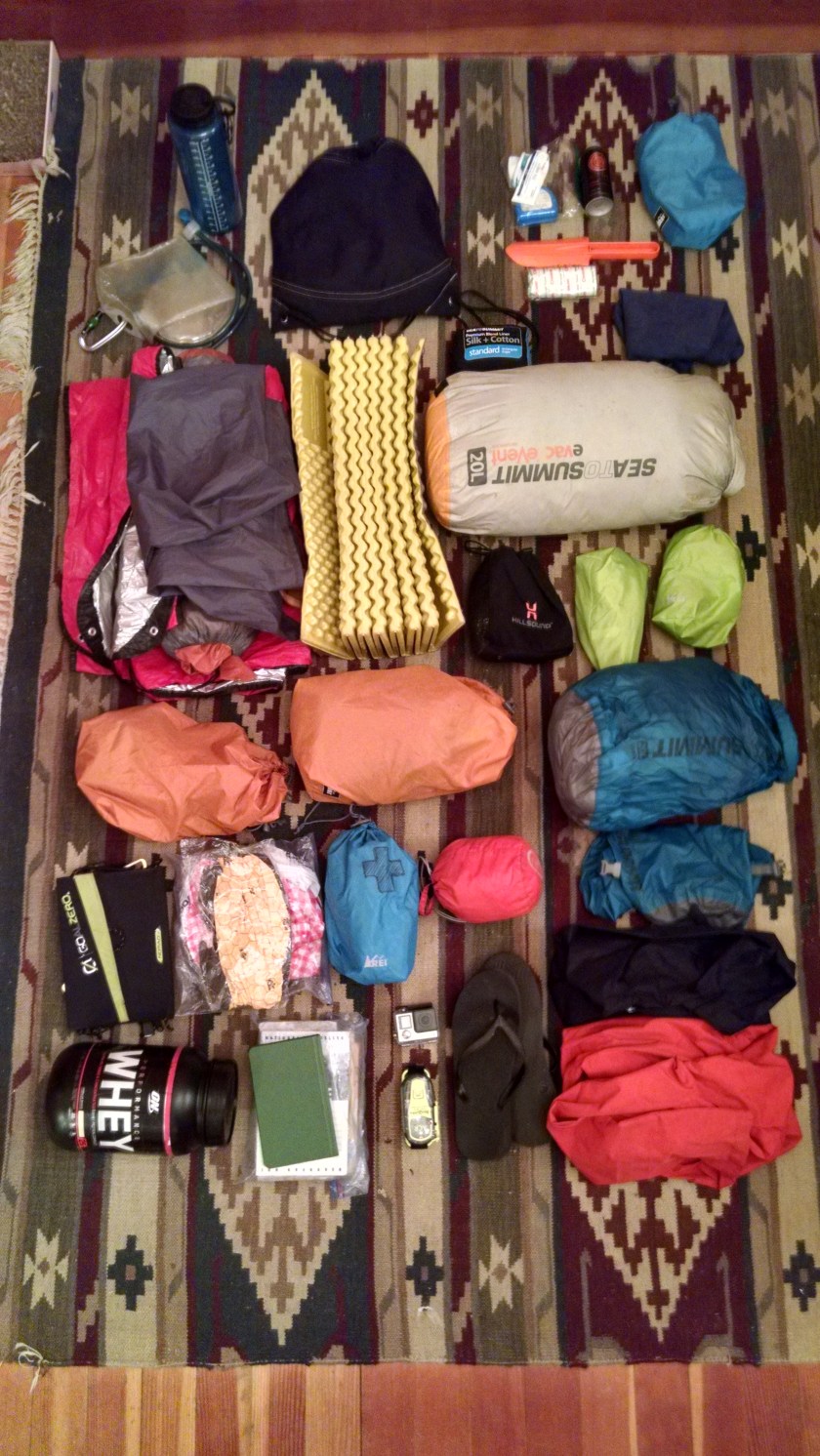
Solo thru hiking pack set up. Items listed below – as pictured from top to bottom, left to right:
1.5L Nalgene bottle, 2L Platypus reservoir
‘quick grab’ bag, pull-string style I wore strapped to my chest
toiletries: halved toothbrush, toothpaste, floss, retainer
spray deodorant (for days I had to go ‘into town’)
(blue) water purification bag (sawyer mini, tablets, back up squeeze bags)
toilet paper
shovel
emergency blanket/tarp with tent and ground cloth, these strapped to bottom of my pack
egg crate style foam pad, also strapped to the bottom
silk blend sleeping bag liner
towl
(white ish) dry bag with sleeping quilt inside, strapped on top of the pack
(black) microspikes bag
(green) misc bag
(green) electronics bag
(orange) gear bag
(orange) kitchen bag
(blue) dry bag for clothes
freebies from le Tour de France
(blue) first aid kit
(red) pack cover
(blue) additional clothes dry bag
food storage jar
maps & books
flip flops
rain pants (black) and jacket (red)
Comments and Observations:
I packed just barely adequate cold weather clothes, everything held up and performed well when needed most. The weather conditions pushed the limits of my gear to the point of low-key winter mountaineering.

