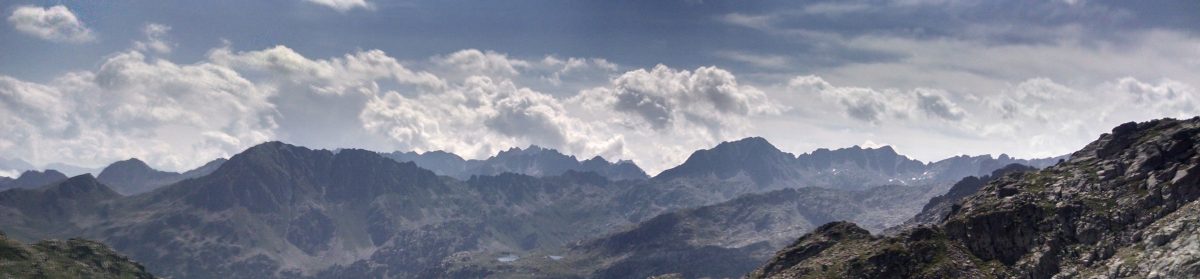
Compared to other long treks, this one proved to be logistically easy. No permits required, no need to mail myself any packages. All of my gear was carried from day one (nothing shipped). Perhaps most importantly, instead of shipping boxes to myself I bought all food/fuel in the villages along the way with occasional hot meals in the staffed huts.
Inarguably the most difficult part of planning this trip is researching and acquiring the necessary topographic maps. Even if you have highly advanced backcountry navigation skills and an intuition for the land, it is pretty much essential to have a full set of maps for the entire range. These, along with the Cicerone guide, will greatly aid your way-finding. I suppose you could set off with just the guide, but does not give you context for alternate routes, villages, roads and supplies. The edition of the guide I used does not give distance, but rather time between waypoints and as a result can be confusing to follow. Know that even with a compass, gps, guide and topo maps, there will still be many instances of conflicting, outdated or unclear markings that make the route difficult to follow. Mountain huts close down, roads have construction and local paths can mislead you quite a distance off-route. Much time will be spent trying to decipher the correct route, though the reality is that so long as you just ‘head towards the sea’ you will indeed eventually get there.
Transportation:
I bought a round-trip flight to Barcelona almost a year in advance to get a decent rate; this required a realistic estimate of how long it would take me to walk from coast to coast and factor in some wiggle room. I ended up with a full week left over to savor the success and soak my tired feet in the Mediterranean. I also realized I’d need to purchase a train ticket from Barcelona to Hendaye in advance so as to ensure I’d get an immediate start on the trail. If I could do it again I’d give myself an extra day for jet-lag and prepare a bit after landing in Spain.
Once on the trail, I never hitched a ride or caught a bus – I wanted to walk on my own two feet for the entire distance from one coast to the other. This meant limiting diverts off-trail to better or more extensive food options. Once in Banyuls-Sur-Mer, it was easy to catch a train to Barcelona again. As I had several items secured to the outside of my pack, it seemed likely for something to get damaged or lost through airport baggage so I bought a large duffle bag that I managed to stuff everything into. This protected the gear during handling but meant I had to discard the bag before going on the trail and consequently, I had to purchase a second one for the flight home.
Food:

Compared to other thru hikes, the HRP is a breeze when it comes to food. With everything else managed, food becomes one of the most critical determinations of a successful through hike. Eating enough of the right kinds of food allows a backpacker to maximize their athletic ability, and I feel like this can be something traditionally overlooked in the outdoor community. I cannot stress enough how eating well can improve one’s convictions during continuous days of long-duration, intensive cardio. This being said, the Pyrenees are dotted with frequent villages and staffed refugios/auberges, you never go more than 4 days between villages/food resupply points; At least every other day you’ll encounter a staffed mountain hut that will serve food (and usually beer).
Yet with all this, apparently I still need to work on my meal strategies on the trail. Despite my best efforts to get enough calories, I lost 20 lbs over the duration of the hike – roughly 1/2 lb per day. Since I was just over 190 lbs at the start, I’m not complaining; however I clearly was not packing and eating enough food on the trail. I gorged myself in every village or staffed hut I came across, and made a decent effort to get as many vegetables and carbs as I could. Despite my diet, still my daily meals were at an enormous calorie deficit. I attribute the fact I was not subsisting on ramen to the reason my ability did not deteriorate while at such a high rate of calorie loss. I had brought a compact camping stove but with the abundance of hot meals and *fresh produce* I eventually ditched the fuel to avoid the prep and cleaning that comes with making your own meals. When on the trail I mostly ate local selections of anything I could find that was both non-perishable and high calorie. Typical items in my food can included dried cheese, salami, cashews/peanuts, tinned fish, bread/crackers, peanut butter and chocolate/nutella. Instead of mailing myself packages of freeze-dried lasagna, I dined in local restaurants, ski villages and staffed mountain huts – the most notable meal being seared duck with potatoes.
Supplies:
I did a pretty solid job of dialing in my needs on the trail; only items that I had to get along the way were a pair of snowboarding gloves (at a certain point my work gloves from Home Depot just didn’t provide the waterproofing and warmth that was needed for back-to-back days of cold, wind and sleet) and a pair of flip flops. I had a pair of really nice, lightweight trail runners I used for creek crossings and as a general camp shoe, but I left them in Refuge Jeandel and so eventually I had to acquire some flip flops. I had a small repair kit and 10 ft of duct tape but all of my gear held up well. In addition to going through the several bottles of sunscreen I packed, I also had to restock sun protection twice – the trail was rather exposed for the whole duration and I saw some hikers that are definitely going to have skin issues later in life.
Culture:
Because the Pyrenees have had centuries of pastoralism, you are never truly too far removed from civilization. In addition to small villages and ski resorts, you frequently pass farms and staffed mountain huts along the route. In fact, there are frequent enough stops that you could almost spend every night in a bed, entirely eliminating the need for a tent. This creates a culture of lightweight backpacking from one hut to the next, where you only need to account for possibility of getting caught in extreme weather and can otherwise keep pack weight to a minimum. However, know that the average price of an overnight stay, with dinner and breakfast, averages €40 to €50 per night, which adds up pretty quick if you’re traveling across the whole range for two months. It’s a bit steep, but bear in mind most of these places are remote so you are paying for convenience. Also something to note is that each accommodation or establishment has its own culture and sometimes rules for patrons. Just because one staffed auberge let’s you camp nearby doesn’t mean the next one will too. One shepherd who’s property you are crossing will be very friendly and generous while another can be guarded and cold towards you.

In addition to saving costs, I wanted the American vision of backpacking, so my pack ended up looking much larger than the average hiker on the trail and got quite a few looks. But it meant I did not have to rely entirely on accommodation and I could seek solitude in a quiet tent, alone in the mountains.

